20 September 2026
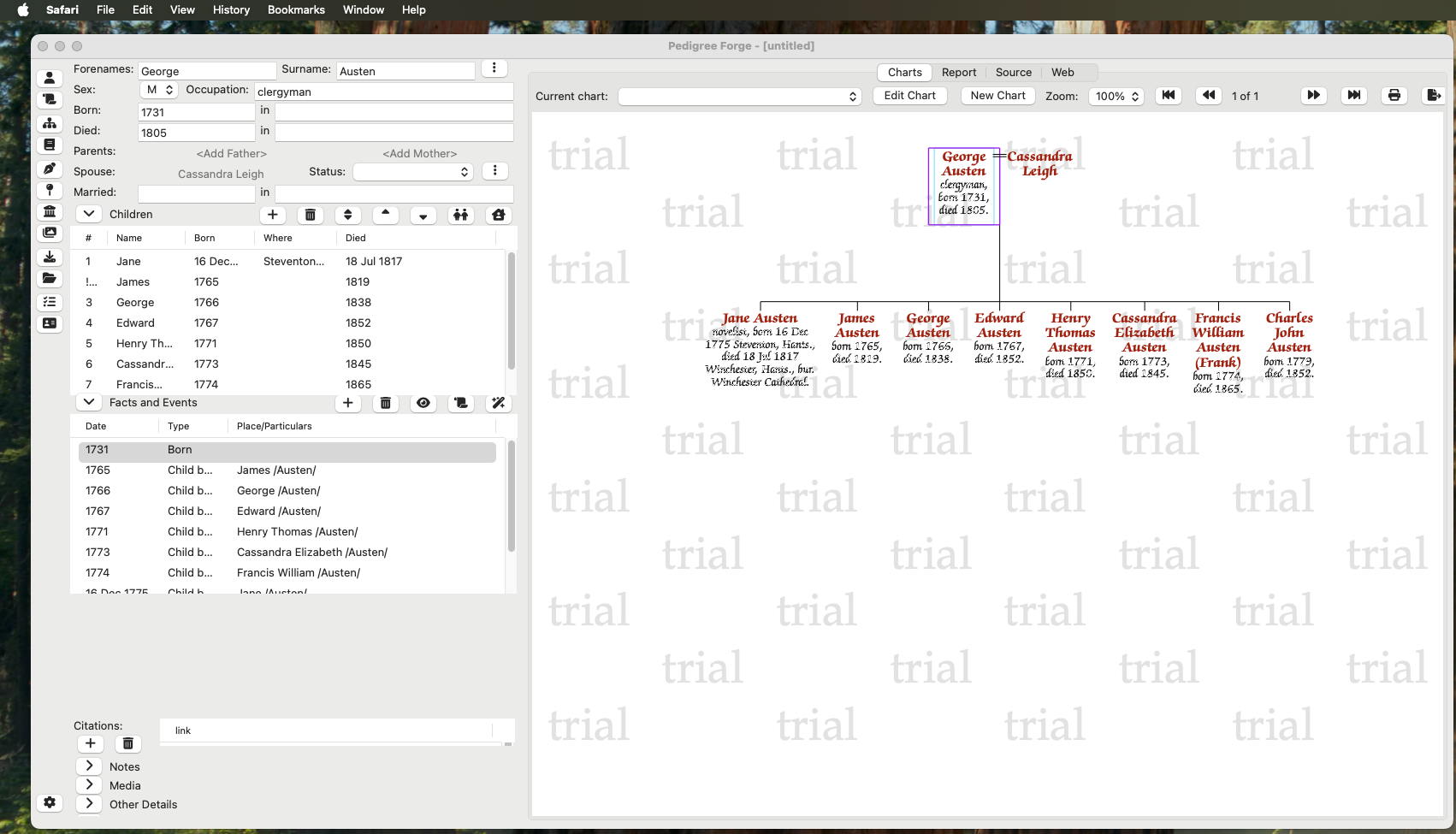
Version 0.9.7 has been released. The headline change is chart drawing and editing — drawing objects and photographs placed on a chart, and a much easier way to arrange them — alongside more export formats, a new Windows printing experience, and a number of smaller improvements.
- Charts — a chart can now carry drawing objects and photographs of your own: text, boxes, ellipses, lines and shapes, drawn straight onto the page, dragged and resized with the mouse, grouped and undone. There are also new style options, including new border styles and a choice of how the linking lines turn their corners.
- More export formats — reports and books export to Word (DOCX), ebook (EPUB) and HTML; charts to PDF, SVG, PowerPoint and the image formats.
- Printing — printing now uses the modern Windows print flow, including preview pages, page range selection and scaling.
- Other minor changes, including importing details from a transcribed census, more information about places in the place helper, birth order now stated automatically in reports, marriages that can be recorded as untraced, changes to how occupations are read, a choice of chapter heading styles, running heads that can be turned off, and a fix for a rare crashing bug.
31 August 2026
Version 0.9.6 has been released. The headline change is chart decoration — drawing objects and pictures placed on charts — alongside a number of other improvements.
Charts
- Drawing objects on charts — a chart can now carry text, rectangles, ellipses, lines and images placed on the page itself, for captions, decorations, crests and engraved borders. Each object is anchored to a compass point of the page so it stays put when the paper size or orientation changes, and SVG artwork saved by drawing programs such as Inkscape now comes in correctly, keeping its position, scaling, rotation, colours and transparency. Dragging and resizing with the mouse is still to come.
- Pictures on people — a photograph, coat of arms or other image can now be attached to a person's entry on a chart, placed left or right of the text, behind it, or above or below it. The entry makes room for the picture automatically, and the picture follows its person through every relayout.
- Ribbon banner titles — a chart title can now sit on a drawn ribbon banner, the scroll of the traditional hand-drawn tree, as an alternative to the existing flourish ornaments. It fits itself to the title, arching to follow a curved title or lying flat behind a straight one.
- Rows that grow to fit — a new Layout option lets each chart row take the height its tallest entry needs, so a row with a photograph in it grows while the rest stay even.
- Highlight duplicate people — a new Layout option shades every occurrence of a person who appears on a chart more than once, and links the occurrences with a curve.
- Export to PowerPoint — a chart can now be exported as a PowerPoint presentation from the ordinary chart export, alongside PDF, SVG and the image formats, arriving on the slide as shapes that can be selected, recoloured and moved.
Editing
- Rich text editing — the editor used for notes and other formatted fields is now much closer to a word processor, gaining merge fields that carry live values from the data, page breaks and horizontal rules, tables that can be kept whole on one page, links that read as words rather than web addresses, and spelling suggestions on right-click.
- Transcript forms — more of the columns on the census, certificate and parish register forms now offer auto-completion as you type, drawing on the trades dictionary and the names already in your file, while preserving exactly what the document says.
- Alias names — seven new kinds of alias cover a change to part of a name rather than all of it, from "John Smith alias Jones" written as the register writes it, to an assumed surname, a later surname, or a woman who kept her own. A person recorded under two surnames is now indexed under both.
Other
- Fixed a bug that sometimes affected the inclusion of images with transparency channels.
- Fixed a problem with the print dialog on some Windows 11 machines.
- Various other minor fixes and refinements.
26 July 2026
Version 0.9.5 has been released. The headline change is improved report configuration via an updated Report panel, alongside a new census transcript template, more chart border styles, and a number of smaller fixes and refinements.
- Improved report configuration — the Report panel has been reorganised around a single tree showing each report and its items together, with the settings for the selected report or item edited directly below the tree. Most item settings that previously opened in separate dialogs are now edited in place, and every change can be undone.
- 1926 Census of the Irish Free State — a new transcript template, following the release of the returns by the National Archives of Ireland in April 2026. The transcript form and printed report table follow the original household return column for column.
- More chart border styles — the chart page border now comes in six drawn styles (thin, thick, thick/thin, thin/thick, double thin and double thick), all recoloured by the existing border colour settings of the chart style.
- Minor fix to text editing with accented characters — double-clicking a word such as "première" now selects the whole word.
- Fixed a rendering issue with fan charts embedded inside reports.
- Fixed a date format bug on charts set to GRO Indexes for dates.
- Various other minor wording improvements.
3 July 2026
Version 0.9.4 has been released. This release concentrates on chart presentation and narrative polish, headlined by two new chart styles and a new "life years plus" chart detail level, along with a number of wording refinements in reports.
Charts
- Two new chart styles — "aldine" (serif) and "lineal" (sans-serif), aimed at clean, publishable charts. Both render names in a normal weight by default, but a key individual can be highlighted in bold using the per-person "Alternative style" flag.
- "Life years plus" detail level — like "life years only", but with the person's occupation or title placed after their name and the life dates shown in brackets, for example "John Smith, blacksmith (1820–1890)".
- Improvements to the "life years only" detail level: folded-in spouses are numbered with marriage ordinals when there is more than one marriage, never-married unions are marked with "x" rather than "m.", and per-person chart notes are now included.
- Better spouse placement in the ancestor part of Hybrid and Ancestor charts — when both partners have deep ancestry, the couple is now pulled in to sit directly either side of their union symbol, rather than being stranded apart beneath their respective ancestor trees.
- Fixed a layout bug where moving one marriage of a spouse group to the right could make a couple's children overlap.
- Fixed the family bar of a compacted spouse-group marriage climbing higher with every fresh layout.
Narrative Improvements
- "Name order varies" option — for people whose given names were recorded in different orders across records (e.g. "Matilda Charlotte" in one place and "Charlotte Matilda" in another). When set, narrative reports note this at the point where the person's naming is discussed, flagging to the reader that the name may be met in more than one form.
- Nicknames in chapter titles — when a person has "prefer nickname" set and genuinely has a nickname, it now appears in chapter titles and timeline headings in speech marks, for example John SMITH "Jack". The "prefer nickname" option is also now applied consistently in the parentage sentence that follows a person's introduction.
- Location wording refinements: timeline entries no longer drop the preposition before an address; a church or venue name now always keeps its town on repeat mentions ("at St Clement, Chichester" no longer shrinks to just "at St Clement"); and parish-style addresses in census and residence entries now read "recorded at St Pancras, Chichester" rather than "at St Pancras, in Chichester".
Other
- Dates entered or imported as GRO civil-registration quarters written as month ranges — "Jan-Mar 1850", "January-March 1850" and similar — are now recognised, as other genealogy applications commonly write quarters this way. Previously such dates were lost on import.
- Fixed life dates showing a bare "0" (e.g. "b.0") for dates imported from other applications that have no usable year.
- Numerous smaller bug fixes and refinements.
6 June 2026
Version 0.9.3 has been released. This is a minor update with the ability to move title and keys on charts interactively and a few small bug fixes.
18 May 2026
Version 0.9.2 has been released. The headline additions are five new chart types — fan, bow tie, circular, direct line and timeline — broadening the chart suite well beyond the existing rectangular pedigree layouts. A handful of smaller features and refinements are included too.
New Chart Types
- Fan chart — a 200° arc opening upward with the subject at the centre and ancestors fanning outward through the generations. The wider-than-180° arc creates a gap at the bottom where the subject's own children are shown. Each grandparent line uses a muted earth-tone palette, lightened gently through the generations. Names and life dates curve along the arcs in the inner rings and rotate radially further out.
- Bow tie chart — ancestors on one side, descendants on the other, with the subject at the centre joining the two halves.
- Circular chart — a full 360° fan, for charts whose proportions suit a complete circle.
- Direct line chart — now a first-class chart type with one-click creation. Pick an ancestor and a descendant, and Pedigree Forge produces a clean vertical chart of the line of descent between them, with off-line families automatically suppressed and a sensible default layout.
- Timeline chart — a Priestley-inspired chart that places people and events along a historical timeline, with subtle period-separated watercolour bands at the bottom.
Improvements to Family Chart Auto-Layout
The auto-layout pass for the main descendant chart engine has been substantially upgraded. The trial-based tighten/compact/restretch passes originally developed in the experimental "quick charts" engine are now merged into the main engine, producing near-optimal layouts without manual tweaking. A new spine alignment post-pass anchors each parent over the child whose subtree carries the line forward, so the trunk of a pedigree stays close to vertical instead of drifting diagonally across the page.
New Marriage Subtypes
Two new "kinds of marriage" can now be recorded on marriage facts, alongside the existing options (banns, licence, civil partnership, common law, etc.):
- Customary marriage — a community-rite ceremony recognised within Romani/Traveller, indigenous, religious or folk traditions where no civil register entry exists. Reports phrase the union as "married by custom".
- Marriage by repute — the Scots-law form (full title "marriage by cohabitation and repute") in which long cohabitation and community recognition conferred full legal marriage. Abolished in Scotland in 2006 but a common encounter in 18th- and 19th-century Scottish research. Reports phrase the union as "married by repute".
Both new types include full glossary entries that appear in the report appendix to explain the term to readers.
Other
- Numerous smaller bug fixes and refinements.
12 April 2026
Version 0.9.1 has been released. This is the largest feature release for some time, building on the new user interface library introduced in 0.9.0. The headline additions are Lua scripting and the new query language, but there are dozens of other improvements too.
Lua Scripting
Pedigree Forge now supports user-written scripts in the Lua programming language, opening up automation, custom reports, and bespoke data queries without needing to wait for new built-in features. Three kinds of script are supported:
- Tool scripts — appear in the Tools > Scripts menu and can do anything from listing children to bulk-tidying data.
- Report scripts — appear in the report builder's drop-down and produce typeset narrative content (headings, paragraphs, tables, lists, footnotes) that flows through the same typesetter as built-in reports.
- Query scripts — appear in the Queries panel and produce tabular results.
User-written scripts go in your Pedigree Forge folder under %APPDATA%, separate from the scripts bundled with the application, so they aren't disturbed by updates.
Most importantly, scripts can create their own interactive dialog windows ("gizmos") for entering and editing data. These dialogs are described with a simple XML layout and can include input fields, drop-downs, tables, and buttons — but the powerful part is that fields can be bound directly to genealogy records. A bound field loads its value from a person, family, or source automatically, and writes any changes straight back to the database. Bound date and place fields even pick up the new entry assistants automatically, so a user-written dialog gets the same calendar picker and place search as the rest of the application with no extra code. Tables can be populated from a query and made editable, so a script can present a custom view of the data and let the user edit it directly. This makes Lua scripting suitable not just for one-off jobs but for building genuine bespoke editing tools tailored to a particular project or research workflow.
A complete scripting guide and API reference is included in the help file.
Queries and the Query Language
A new Queries panel (under Tools > Queries) lets you search, filter, and explore your data without writing scripts. Pedigree Forge ships with a set of ready-made queries, and you can create your own using a SQL-like query language designed for genealogy data:
SELECT surname, given_names, birth.date AS "Born"
FROM persons
WHERE birth.date.year > 1800
ORDER BY surname
The language can search people, families, facts, sources, archives, and places. Results can be shown as a read-only table, an editable grid (where the underlying data supports it), or a detail view. Double-clicking a row jumps straight to the record. Queries can take parameters — for example a place name or a date — and the results refresh as you change them. An "auto update" option keeps the results in sync with the underlying data while you're editing.
Query results — and the contents of the audit panel — can be exported to PDF, CSV, TSV or HTML with one click. PDF export uses the same typesetter as the main reports, so long results flow neatly across multiple pages with the column headings repeated on each page.
Data Entry Assistants
Date and place fields throughout the application now have a small assistant button (also accessible by pressing F2) which opens a dedicated dialog to help with structured entry:
- The Date Entry Assistant covers all of Pedigree Forge's supported date types — single dates, periods, ranges, GRO quarters, terms, decades, regnal years, and free-form phrases — across Gregorian, Julian, French Republican and Hebrew calendars. A live preview shows the date in full, compact, minimal and decorated formats, with country-specific calendar validation.
- The Place Entry Assistant searches the entire place database with prefix, substring, or fuzzy (phonetic / Levenshtein) matching, optionally restricted to a county. Ambiguous place names are flagged so you can pick the right one.
Improved Audit and Live Warnings
The live audit warnings shown in the status bar have been redesigned. Warnings are now classified into three severity tiers — error (red), warning (amber) and information (blue) — with coloured count badges in the status bar. Clicking the warning area opens a flyout listing all current warnings as colour-coded chips; each chip can be dismissed individually, ignored permanently, or used to navigate to the relevant fact.
Reports and Typesetting
- Continuous scrolling view mode for reports, in addition to single-page and two-page views. Page rendering is culled to what's on screen so performance stays smooth in long documents.
- Cross-page hyphenation avoidance — the typesetter now reworks lines around page breaks to avoid hyphenated words splitting across a page turn, where it can be done without compromising line spacing.
- Balanced line breaking for centred headings and image captions, distributing the text evenly across lines and avoiding awkward orphans.
- Warning indicators on the report viewer toolbar to flag drafts and "staged facts as list" mode, to prevent accidentally printing with debug settings on.
Narrative Improvements
- Better handling of extramarital children, with explicit "Outside of this marriage…" phrasing and the other parent named in full.
- Age gap inference in the family life narrative — when a couple's birth dates suggest a difference of ten or more years, the narrative observes this with appropriately approximate phrasing.
- Occupation at time of death now appears in the last residence sentence (e.g. "was recorded as a carpenter").
- Disambiguation of duplicate child names — when a couple had multiple children of the same name (often after the death of an earlier sibling), the narrative now distinguishes them ("another John", "yet another John", "the second John").
- Census household analysis distinguishes dependent children from adult offspring still living at home.
- Numerous smaller wording, punctuation, and grammar refinements throughout.
Charts
- Interactive navigation chevrons on dynamic charts. Semi-transparent up-chevrons appear above people whose ancestors aren't currently shown, and down-chevrons at the depth limit. Clicking moves the chart to that part of the tree; hovering shows a tooltip with the target person's name.
Editing and User Interface
- Find bar in the rich text editor — Ctrl+F opens a VS Code-style incremental find bar with match highlighting and "X of Y" navigation.
- Link editing — right-clicking a footnote, source citation, person index entry, hyperlink or place link in rich text now offers an Edit option.
- A new Fact Details / Witnesses dialog with a Details tab (age, trade, cause, address, place, residence, agency, religion, time, research note) and a Witnesses tab.
- Drag-and-drop of image files onto the gallery, the source list, and the source media area to add photos and source images directly.
- Tab management — tabs can be reordered, dragged, and moved between the left and right side panels via right-click or drag-and-drop.
- Multi-line cells in editable tables and property grids, with word wrapping and overflow indicators.
- Insert and delete row support in the editable transcript tables (currently 1861–1901 censuses).
- WW1 army forms transcripts redesigned with a tabbed interface where forms are added and removed dynamically.
- "Preferred family" — for people with multiple families as spouse, you can mark one as preferred so it's the default when navigating to that person.
- A small badge on the Notes section showing how many notes contain content for the current person.
- Smart zoom — Ctrl+mouse-wheel zoom on charts and reports now keeps the point under the cursor stationary instead of zooming toward the corner.
- The help viewer is now a separate window that can be left open on top of the main window, so you can keep the help visible while working in the main application or while a dialog (preferences, file picker, etc.) is open.
Other
- New "Began relationship" event for couples who never married or who didn't marry until much later.
- Numerous bug fixes and smaller refinements.
6 March 2026
Version 0.9.0 has been released. This includes the following changes:
- Switch to new user interface library, which allows faster, hardware accelerated rendering, including new controls and support for themes and dark mode. This is a large change, but crucial to implement before version 1.0.
12 January 2026
Version 0.8.20 has been released. This includes the following changes:
- Ability to mark on a family chart a "line of interest", often used to show the direct line back for a family - see information in the help file.
- Fixed bug that sometimes caused the rich edit control to lag on certain computers.
- Fixes for minor bugs and performance tweaks.
23 November 2025
Version 0.8.19 has been released. This includes the following changes:
- British Place Database with External Cross-Linking - Places throughout Britain now link seamlessly to authoritative external resources including Wikipedia articles, Vision of Britain historical records, Google Maps for modern locations, and the National Library of Scotland maps service for historical cartography. These cross-references provide instant access to geographical and historical context for locations mentioned in reports.
- Improved Census Narrative Generation - The narrative engine now generates comprehensive census facts throughout individuals' lifetimes with customizable detail levels. Users can control how much census information appears in reports, from brief mentions to detailed household composition.
- Refined Date Estimation for GRO Quarter 1 Registrations - When births or deaths are registered in Q1 (January-March), the system now intelligently analyses related events such as baptisms or burials to narrow date ranges beyond standard "late/early" classifications, producing more precise estimates where supporting evidence exists.
- Bug Fixes: Fixed intermittent crash when repeatedly closing and reopening the report edit panel.
25 August 2025
Version 0.8.18 has been released. This includes the following changes:
- Enabled option to show nicknames in speech marks on charts, rather than brackets.
- Changed behaviour of how photos are pulled into report chapters—if there are photos of children of a couple who have a chapter, but the child has no chapter of their own, these are now included in the parent's chapter.
- Changed default configuration when creating new charts to always show spouse to the side of a descendant, whereas the previous default was to tuck their entry into the descendant's entry, if there wasn't much information on them. The old style is still possible to create, but the default has now switched.
- Improved behaviour with the downloaded files watcher, so as to automatically close in a more intuitive way.
- Fixed bug that could cause a bad sentence to be generated in a report when someone had an alias name but no parents.
- Corrected bug that when using "save as" didn't update the visible file name shown in the title bar.
- If someone's biological parents died before they were 15, this is now noted in the child's timeline.
- Implemented early (and experimental) changes to allow creation of AI friendly reports, for pasting into AI agents, like ChatGPT/Claude. This feature is not yet available in production copies of Pedigree Forge.
- Minor usability bug with some of the source templates (1754 marriage types) notably, focusing the first editable field when opening.
12 June 2025
Version 0.8.17 has been released. This is a minor change version, with aa few minor bugs fixed.
- Hardening of importing GEDCOM files created from other applications: person that had been linked as their own parent detected on import (not possible to create a person linked as their own parent in Pedigree Forge).
- Fixed recursion bug that caused a crash when trying to calculate a relationship with someone who was linked as their own parent (can't happen in Pedigree Forge, but could in imported files).
- Fixed regression bug which prevented the import log from being opened with the default viewer application, after a GEDCOM file imported.
9 June 2025
Version 0.8.16 has been released. This is a minor change version, with a few minor bug fixes and small features.
- Minor bug fix that sometimes caused a rich text box to not completely redraw.
- Minor changes to how user interface is presented for custom styles, in relation to the use of wordy text, justification and commas after names.
- Added a new "built in" chart style "Georgian", that allows the persons name and their information to appear on a single line (if there is space), and renders in the same style.
- Narrative for main chapter now picks up on, and mentions, if one of the subjects of the chapter was a twin or triplet etc.
- The "to do" grid now displays a tick for a completed item, rather than a Y.
- Live auditing now checks for children born when parents too old/too young, in reverse order, which means that, as long as the children are sorted (which is flagged as the warning with higher priority), rejects returning the child born latest first.
- Added option to right-click chart editing menu to allow (or not allow) lifting of the family bar.
- Better default positioning of transcript dialog, when it is shown, for various scenarios.
- When panning charts by "grabbing" the chart canvas, fixed non-intuitive behaviour which selected the person under the mouse when it was released.
- Added the ability to have "son and heir", "daughter and heiress" or "daughter and coheiress" show in main narratives and on family charts. These are picked up if an association is set on the father, with a relationship set heir/coheir/heiress/coheiress as appropriate.
- Changed the dialog used for entering relationships on assocations to have a combobox with some standard suggestions (with ability to enter another value), rather than a text prompt box.
26 April 2025
Version 0.8.15 has been released. This is a minor change version, with a few minor, and one major, bug fixes.
19 April 2025
Version 0.8.14 has been released today. This version includes the following new additions/changes:
- Some data audit checks/warnings are now run "real-time" and show in the status bar of the application. This can be set to be ignored if they aren't applicable.
- Chart editing properties are now modified in a side panel (Chart Properties), rather than a floating dialog, and can be made "live" rather than having to enter a special editing mode. There is more space here for them to be arranged logically, and use is more intuitive than the floating dialog.
- As part of the work on chart editing, charts are now shown centred, rather than to the left, when space is available.
- Shared notes and people notes also now open in a side panel, rather than in floating dialogs.
- Option to make the transcription dialog semi-transparent, to help with transcribing text.
- Improved default zoom levels for charts, sources, and reports, based on screen size and resolution.
- Changes to the Windows User Interface backend code, so that "high contrast" modes display correctly.
- Fixed a bug that sometimes caused "laggy" behaviour when spell-checking rich text input boxes.
- Fixed a bug that sometimes caused the rich text boxes to change vertical scroll position during spell-checking, when entering text on the last line of the rich text box when scroll bars were present.
- Placement of vertical scrollbars in some of the key edit panels, to help when using on smaller screens.
- Removed the vertical scrollbars on small text area boxes in the transcript forms, where only a small amount of text is expected (such as census transcript boxes), to make better use of available space.
30 March 2025
Version 0.8.11 has today been released and is available to download. Users with an earlier version should be updated automatically the next time they run Pedigree Forge.
Changes have continued to focus on small tweaks to internal code, particularly that which touches the user interface and operating system. Some of these can be rather time consuming to get right. For example, differences in user interface between Windows 10 and Windows 11, show slight differences.
The changes to the operating system code has been to bring the application in line for possible future submission to the Microsoft Store.
The latest version also fixes a bug that caused a file to hang on loading.
There are now early version of Pedigree Forge for Apple Mac (using the native Cocoa user interface), and Linux (using GTK). These aren't a high priority, but the application was written with portability in mind. The ports for MacOS and Linux aren't available for download to users (still vapourware at this stage), but if there is demand, they will be developed further.
Compiling code with for different platforms and architectures helps show hidden bugs, which only manifest under these conditions. Pedigree Forge now compiles under Windows (MSVC), Mac (AppleClang) and Linux (GCC).
10 March 2025
Changes over the last month or so have been smaller in scope. They have concentrated on bug fixes, to have a stable version available for the public beta.
The following changes have been incorporated since the last update:
- Added ability to include quarter dates on charts (which is configurable).
- Added a context menu to the rich text editor, so that some basic formatting can be added directly close to the text, rather than requiring use of the tool bar.
- Fixed a bug that could cause spell checking to be slow in the rich text editor.
- Fixed bug that very occasionally caused a crash when adding citations from the adding children dialog.
- Fixed bug with rich text editor that ignore paragraphs that only contained hyperlinks.
- Fixed bug that sometimes caused clicking on an item in some of the table grids to not select the correct item under the cursor (underlying cause because of changing the data model which changed the table before interpreting the click).
- More user friendly description of positions above in charts, i.e. "Above left most child node", rather than "1"
- Minor changes to how life dates are generated when there isn't a date of birth, only a baptism.
- Improved wording for certain London and neighbourhood churches when used in baptisms, marriages and burials in narrative report.
- Fixed rare bug that could cause issues with auto width nodes combined with force new line for each fact, whereby nodes would be made very large.
- Fixed bug that caused a parent to be returned as both the mother and the father, if there was an irregular combination of sex for the person record and role in the family record.
- Changes to measurements used for collapsible panel headers and menu icons, to improve appearance when high DPI settings are enabled.
- Fixed bug that could cause the program to fail importing a GEDCOM file if there was an unrecognised tag in a family record.
- Added the ability to set heraldic tinctures for chart colours.
- Hardened loading of JPEG image files for use in reports, as some invalid JPEG files could cause a crash.
- Fixed behaviour of right-clicking on a grid that didn't have focus, so that the right-click context menu is that for the grid as expected.
- OBJE on FAM records are now imported and exported. Pedigree Forge does not uses these internally, and these are included for GEDCOM compatibility only.
- Added a grid that shows media objects that are linked to a family record, and allows them to be deleted (for GEDCOM compatibility; Pedigree Forge does not use these).
- Made the default handling of folded places on charts (i.e. drop counties on subsequent occurrences) to off.
In addition to user visible improvements, there have been some behind the scenes changes in preparation for a possible future Mac (using the native Cocoa UI) and Linux (using GTK) versions. There is a very early version that now runs on both, although a lot of work is still needed on the user interface and isn't a priority at present.
1 February 2025
Version 0.8.0 has today been released to testers. The jump in version number is to reflect the progress of the project, and a version in the 0.8 cycle will likely be released as a public beta.
The following changes have been incorporated since the last update:
- Improvements to web searches
- Ability to turn off the file watcher, used to help with creating sources from downloaded files
- Ability to work with a GEDCOM file to create a linked chart, but without fully importing the GEDCOM file. Useful for creating charts but using a different software package for editing data.
- Improvements to logic used when working with tabs in the internal web browser.
- Minor changes to how parent unions are positioned relative to their children.
- Improvements to creating children with only one known parent.
- Added ability to force each fact on a chart to be on a new line.
- Fixed rare bug in relation to rich text after crash recovery of a file.
- Added ability to add a place to the list of valid places from where it is entered, rather than having to go an add elsewhere.
- Minor changes to welcome screen, to allow access to the quick start video.
11 January 2025
Version 0.5.7 has today been released to testers.
The following changes have been incorporated since the last update:
- Ability to add user "tags" to people in the project, that can be shown on charts and reports.
- Switch to Microsofts MSIX app package installer.
- Many minor tweaks to user interface.
- First "full" version of user guide and help file provided.
- Switched user activation codes to be based on user only, so can user can more easily install on multiple devices.
- Added gender as a field that can be entered separately to sex.
- Added ability to change search engine and add or remove bookmarks to built-in browser.
- Added ability to clear the built-in browser's cache.
27 Dec 2024
Version 0.5.0 has today been released to testers.
The following changes have been incorporated since the last update:
- Improvements to audit and validation. It is now possible to audit only a subset of records in a file and flag warnings to be ignored in future.
- Improved handling of multiple families for adopted people, so that birth and adopted families can be included, along with configuration of which or both, to include in charts and reports.
- Added option that can show sex on a family chart—useful with male names that were sometimes female in the past, and vice versa.
- Added option to choose home page used by external browser.
- Created first draft of user guide, now covers most functionality.
- Improved appearance of borders on the rich edit controls.
- Spell checker now reads in custom user dictionary as used by other Windows applications.
- Added ability to space spouses on charts closer together, lifting a family line up if needed.
- Added forms for Queensland civil births/deaths/marriages.
- Added ability to always include the county level on charts, even for well-known places.
- Internal changes to how flourit dates are stored.
- Improved GEDCOM compatibility: implemented object record link imports in more places.
- Improved GEDCOM compatibility: normalising the characters used for record identifiers when importing.
- Improved GEDCOM compatibility: import and export restriction notices (RESN) tags.
- Improved GEDCOM compatibility: implemented importing of more places where notes are allowed in GEDCOM.
- Improved GEDCOM compatibility: implemented importing of address and contact details on arhives (REPO) records.
- User interface: added collapsible panels to various places on the person and source edit panels, to work better on smaller screens.
- User interface: implemented ability to show/hide edit panels, so more space can be used to edit charts visually, useful for smaller screens.
- User interface: added option to use external browser, for people who don't want to used the built in web browser.
8 Dec 2024
Version 0.4.1 has today been released to testers.
The following changes have been incorporated since the last update:
- Fixed drawing bug where charts would sometimes look "blurry" the first time they were drawn after the program started.
- Changes to recognising, validating, and processing "dual dates", to incorporate places where the new year began on dates other than 1 January. Note: "Lady Day" Style, where 25 March was used was already supported, but now added support for "Christmas Style" and "Easter Style" will now also work too. Validating takes into consideration some place knowledge, where available-For example, warning given if dual date used after 1600 in Scotland, but not in England until 1752.
- Added recognition for other calendar types. Gregorian is the default, but Julian, French Republic and Hebrew are supported too.
- Changes to how dates are parsed, stored and sorted.
- Added User Interface to Media Gallery, to see which people are linked to the media object.
- Changes to recognition of places, so more places are recognised. Places can be entered with, or without, a country, so long as there is a "county" or "state" level.
- Improved optimisation of loading and saving large files. Reduced loading large "real" file (109MB in size, with 340,000 records of varying types, with realistic data) to loading 1.9 seconds (when warm) and store in 1.2 seconds (again, when warm).
- Changes to the user interface so that load, importing, and merging files show a busy dialog whilst the operation is happening.
25 Nov 2024
Version 0.4 has today been released to testers.
The following changes have been incorporated since the last update:
- Fixed crash bug when right-clicking on children in fact list (regression) introduced when allowing duplicate facts (e.g. more than one marriage between a couple).
- Added option to allow specifying how frequently Pedigree Forge checks for updates.
- Added option to re-open the last file that was being worked on (unless there was a crash).
- Added (very basic) e-commerce ability to allow users to register.
11 Nov 2024
Version 0.4 is nearly ready for release to testers. Below are the main visual changes made during the 0.3 to 0.4 release cycle:
- Undo, to undo the last change.
- Media gallery panel, to more easily add photos.
- Integrated image editor, to edit images added to sources.
- Various user interface changes, to work better on smaller screens.
- Option to specify that surnames use UPPERCASE when creating charts/reports.
- Option for charts to use "Chapman" codes for counties.
- Added extra "audit" checks for children with the same given name and years of birth compared to their parents.
- Changes to the main menu bar.
- Ability to add multiple facts that usually only occur once, for example, multiple marriages between the same two people, and to set one as the preferred date.
- Added ability to add someone's name in their native language, which shows in the reports and on the charts (font support permitting).
- Added ability to specify pronouns for people, used in report and shown on charts.
- Saving last state of window on close, so will either reopen maximised or regular next time.
- Added user interface dialogs to configure various aspects of report configuration, rather than rely on entering specific text and IDs.
- Source viewer now automatically updates as new images are added/deleted.
- Find person dialog and find family dialogs, now default to case in-sensitive searching.
"Behind the scenes" changes include:
- Switching default mode to use an SQLite database, so no need to "save" changes, all are applied automatically.
- Switched storing of rich text to html.
- Improvements in GEDCOM import, including showing a report of exceptions.
Bug fixes include:
- Multiple tables next to each other in rich edit being merged together.
- Fixed bug where the spouse order number over the "=" was sometimes wrong with an unmarried spouse before.
- Fixed installer bug where file associations weren't setup correctly.
- Fixed a bug where soft line breaks were sometimes ignored.
- Fixed bug where empty rich edit text didn't default to being justified.
- Fixed bug where children that weren't necessarily out of birth order (as no date given) were sometimes flagged as such.
- Fixed bug that sometimes caused selecting someone in the person dialog would pass the click through to the underlying chart and potentially move to the person clicked on the chart.
11 Oct 2024
Website created and version 0.3.0 released to beta testers. Major features in this release include the built-in word processor. Development already well advanced for 0.4.0.